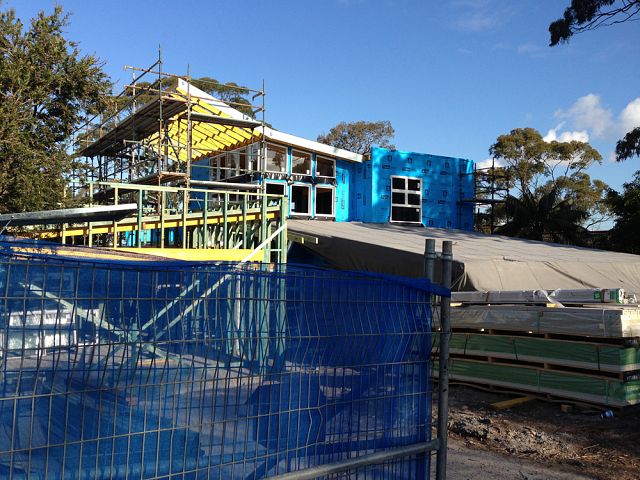
Week 8 just complete and the majority of the external framing is now in place. We were excited to see the roof framing for the first floor deck erected. The adjusted angle from the main first floor roof creates a striking finishing statement and balances the proportions of the other elements of the home. Always good to see those decisions made on paper beginning to realise themselves on site!
Kinking the roof angle allows for the winter sun to penetrate into the upper level living spaces during the middle of the day and create an open, yet covered feel to the deck below. Its impact when viewed from the street as an architectural element is also creating some ‘interest’ in the otherwise quite little suburb of Davidson.
Image above of the build when viewed from the street boundary as of 14th August.
This week I wanted to discuss contingency within a building contract. A contingency is basically an amount of money available for use, if needed, if the scope of the project needs to change. The intent is not to use this contingency if at all possible, but to have it available if unavoidable. We generally suggest, for the types of projects we are working on that 5-7% of the contract cost would be a reasonable contingency to have available.
There are three key areas that variations fall into that may require you to call on a contingency. Contrary to popular belief they aren’t generally because the architect wants to make things more expensive because “C’mon…its going to look fantastic!”
Variations are most commonly caused by changes to the scope requested by the client, generally related to fixtures and finishes amendments, electrical upgrades or joinery additions. Or, unforeseen circumstances, like wall framing with termite damage not able to be seen until demolition has begun for example. Also, less commonly, variations can come about due to changes in the design suggested by the architect. This does not necessarily mean the variation is an addition to the cost. It can also be a reduction in the cost or be cost neutral.
In reference to this project, we have worked closely with the builder and the client to resolve details for balustrades, awnings, screens etc that were amended during the tender stage in an effort to reduce costs. The original designs were outside of the overall budget and based on this, allowances were set at the time of contract signing for these items. As construction progressed we revisited the designs for these elements and presented to the builder for pricing and comparison with the allowances made.
All of the time we have been working hard for the client to retain the intent and finish quality of the original design intent whilst making these changes ‘cost neutral’ when compared against the contract allowance. We continue to work with the builder work shopping alternative methods so this can be achieved.
So remember, your architect is there to help achieve an outcome in line with the brief for the project, that always includes a budget. Ignoring this fact when considering the value of variations particularly would make for an unhappy client and an architect who is not acknowledging the parametres of the project.
Design is very easy when there is no budget…. but it is much more challenging and rewarding when there is, and a good design outcome can be achieved.
 Facebook
  Houzz
Houzz  Linkedin